
A bim manager course only makes sense once you understand what actually changes between a BIM modeler, a BIM coordinator, and a BIM manager. The job titles sound similar, but the daily work, the software time split, and the way you get evaluated shift considerably at each stage. This article breaks down that progression step by step, what a bim coordinator course adds on top of foundational BIM training, and how to signal to an employer that you are ready to move up.
Key Takeaways
- A bim manager course sits at the end of a progression, not the start, moving from modeler to coordinator to manager.
- A bim coordinator course adds clash detection, shared model management, and cross team communication skills on top of foundational modeling.
- Signaling readiness for coordination roles matters as much as the certification itself when applying for a promotion or a new role.
From BIM Modeler to BIM Coordinator: What Actually Changes
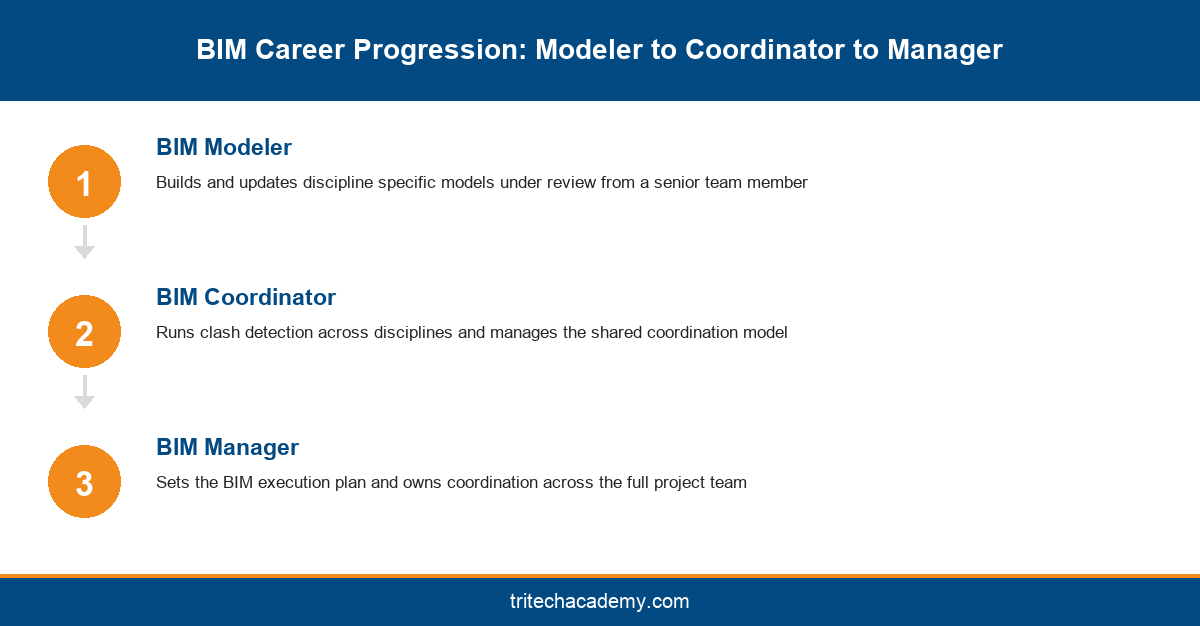
A BIM modeler spends most working hours inside a single discipline model, building walls, ducts, or reinforcement details and updating them as design changes come in. The work is largely software execution, following a BIM execution plan someone else has already set, rather than making decisions about how disciplines should coordinate with each other.
A BIM coordinator takes on a different kind of workload. Instead of building one model, they pull together the architectural, structural, and MEP models into a shared coordination file, run clash detection in Navisworks, and flag conflicts back to each discipline lead for resolution. The software time drops while communication time increases, since a coordinator spends real hours explaining clashes to modelers who did not create the model they now need to fix.
This shift usually happens gradually rather than through a sudden title change. A modeler who consistently flags coordination issues during their own modeling work, rather than waiting for a coordinator to catch them later, often ends up handling small coordination tasks informally before the job title ever changes. Employers tend to notice this pattern before any formal bim coordinator course appears on a resume, since it shows the underlying judgment the role actually requires. Waiting passively for a promotion to be offered, without demonstrating any of this behavior first, is one of the more common reasons capable modelers stay in that role longer than their technical skills alone would suggest.
What a BIM Coordinator Course Adds to Foundational BIM Training
A foundational BIM course teaches you to build a model correctly within your own discipline. A bim coordinator course assumes that skill already exists and instead focuses on federated model management, clash detection workflows, and how to read a BIM execution plan rather than simply follow one someone else wrote.
Where this matters most is in the software mix. Coordinator level training spends far more time in Navisworks and common data environment platforms than in Revit itself, since the coordinator’s job is reviewing and merging work other people modeled, not authoring new geometry. Tritech Academy’s MEP Integrated BIM course introduces this kind of cross discipline coordination earlier than a single discipline course would, since MEP work by definition depends on constant coordination with structural and architectural models.
Beyond software, a bim coordinator course typically covers how to write and interpret a BIM execution plan, how to set level of development requirements for each project phase, and how to document clashes in a way other disciplines can act on without needing a follow up meeting to understand what the coordinator meant. This documentation skill is easy to underestimate but shows up constantly in the actual job, since a poorly written clash report often causes more delay than the clash itself. Programs that skip this documentation and communication component and focus purely on Navisworks button clicking tend to produce coordinators who can find clashes but struggle to get them resolved quickly.
Day to Day Responsibilities at Each Stage of a BIM Career
A typical day for a BIM modeler involves updating assigned model elements, checking them against the latest architectural or structural drawings, and submitting the updated model for review by a senior team member. Most decisions about how the project should be coordinated are made above them, not by them.
A BIM coordinator’s day looks different, running scheduled clash detection sweeps, documenting unresolved conflicts, and chasing responses from discipline leads who may be behind on updates. A BIM manager, one level above that, spends time setting or revising the BIM execution plan itself, managing client expectations around coordination deliverables, and making the final call when two disciplines cannot agree on how to resolve a clash.
The clearest way to see this difference is to compare how each role spends a typical eight hour day. A modeler might spend six or seven hours actively modeling, with the remainder in review meetings. A coordinator often flips that ratio, spending only two or three hours directly inside modeling software and the rest reviewing federated models, writing clash reports, and following up with discipline leads. A BIM manager spends comparatively little time in modeling software at all, with most hours going toward planning documents, client meetings, and resolving disagreements between coordinators or discipline leads who cannot settle a conflict on their own.
How to Signal You Are Ready for a Coordinator or Manager Role
Certification alone rarely convinces an employer that someone is ready to move from modeling into coordination. What tends to work better is being able to point to specific instances where you already did coordination adjacent work, flagging a clash before it was formally assigned to you, or explaining a modeling decision to another discipline in a way a non modeler could understand.
A bim manager certification helps validate that you understand execution plans and federated model management in principle, but pairing it with real examples of cross discipline communication is what actually moves a hiring manager. According to the Project Management Institute, communication and stakeholder coordination consistently rank among the skills that separate technical specialists from people ready for management responsibility, and BIM coordination roles are no exception to that pattern.
One practical way to build this track record is to volunteer for cross discipline walkthroughs even when it is not formally part of your assigned role, since these sessions expose you to how other disciplines think about their own models and where friction tends to occur. Keeping a simple record of specific coordination issues you helped resolve, even informally, gives you concrete examples to discuss in an interview or performance review rather than vague claims about being ready for more responsibility. This kind of documented experience tends to carry more weight with hiring managers than a bim manager certification earned without any coordination exposure behind it.
Building Toward a BIM Manager Course the Right Way
Jumping straight into bim manager training without first working as a modeler and coordinator usually backfires, since the coordination decisions a manager makes only make sense once you have personally dealt with the modeling and clash resolution work those decisions affect. Skipping stages tends to produce managers who understand the theory but struggle with the practical judgment calls the role actually requires. Reviewing Autodesk’s own certification standards alongside your current experience level is a useful way to check whether you are pursuing a bim manager certification for the right reasons, rather than simply because it is the next credential available.
Engineers who train through a specialization like BIM for Civil and Structures or BIM for Architecture, then build modeling and early coordination experience before pursuing a bim manager course, tend to arrive at management responsibility with a stronger practical foundation than those who chase certifications in order without the project experience behind them. You can review Tritech Academy’s full course catalogue or contact the admissions team to plan a progression that matches where you currently stand.
There is no universally correct amount of time to spend as a modeler or coordinator before pursuing a bim manager course, since project complexity and how much coordination exposure a role actually offers vary considerably between employers. Someone working on small residential projects with limited multidisciplinary coordination will likely need longer to build relevant experience than someone placed on a large commercial project with heavy MEP and structural coordination from the start. Rather than targeting a fixed number of years, it makes more sense to track whether you have handled the specific responsibilities described earlier, execution plan input, clash documentation, and cross team communication, before investing in manager level certification.
Conclusion
Moving from BIM modeler to coordinator to manager is a gradual shift in responsibility, not a single certification event, and a bim manager course works best when it builds on real modeling and coordination experience rather than replacing it. If you are mapping out that path, explore Tritech Academy’s BIM specializations or get in touch to talk through which stage you should focus on next.
Frequently Asked Questions
Is a bim manager course worth taking early in a BIM career?
Not usually. A bim manager course works best after modeling and coordination experience, since the execution planning and clash resolution decisions it covers only make practical sense once you have handled that work firsthand.
What is the main difference between a BIM coordinator and a BIM manager?
A coordinator runs clash detection and manages the shared model day to day. A manager sets the overall BIM execution plan, owns client communication around coordination, and makes final calls on unresolved conflicts between disciplines.
Does a bim coordinator course require prior software certification?
Most bim coordinator course programs assume foundational modeling skills already exist, whether from a BIM for Architecture, civil, or MEP course, since coordination training builds on modeling knowledge rather than replacing it.
How long does it typically take to move from modeler to coordinator?
There is no fixed timeline, since it depends on project exposure rather than time served. Engineers who seek out cross discipline coordination tasks early tend to move into coordinator responsibilities faster than those who only complete assigned modeling work.
What software should I focus on before a bim manager certification?
Navisworks and common data environment platforms matter more at coordinator and manager level than Revit alone, since the work shifts from authoring models to reviewing, merging, and resolving conflicts across multiple discipline models.
Can BIM modelers from any discipline become BIM managers?
Yes, BIM managers come from architectural, structural, and MEP modeling backgrounds. What matters more than the original discipline is coordination experience and comfort managing communication across teams that do not report to you directly.
Is bim manager training different for MEP specialists?
The core coordination skills are similar, but MEP specialists often encounter clash detection earlier in their careers, since HVAC, electrical, and plumbing systems constantly clash with structural elements, giving them earlier informal coordination practice.
Where can I start building coordination experience before enrolling in a bim manager course?
Ask to sit in on clash review meetings even before it is formally part of your role, and volunteer to explain modeling decisions to other disciplines. You can also review Tritech Academy’s About page for more on how its training connects to real project work.