
Understanding a BIM course fee before you enroll saves you from unexpected costs halfway through training. Course fees for BIM programs are rarely a single flat number, they usually bundle several distinct cost components together, and how those components are structured varies from one institute to the next. This guide breaks down what a BIM course fee at Tritech Academy typically includes, how pricing can differ across BIM for Architecture, BIM for Civil and Structures, and MEP Integrated BIM, and the exact questions you should ask before committing to any quote.
Key Takeaways
- A BIM course fee usually bundles software licensing, certification exam costs, project materials, and placement support rather than charging for each separately.
- Fee structures can vary by specialization, since BIM for Architecture, Civil and Structures, and MEP Integrated BIM each use different software licenses and project materials.
- Requesting a written fee breakdown before enrolling is the clearest way to avoid hidden costs partway through your BIM course.
Typical Cost Components in a BIM Course Fee
A BIM course fee is rarely just tuition for classroom time. Most legitimate programs bundle several distinct cost components into a single quoted price rather than charging separately for each one, which is worth understanding before you compare quotes across different training institutes.
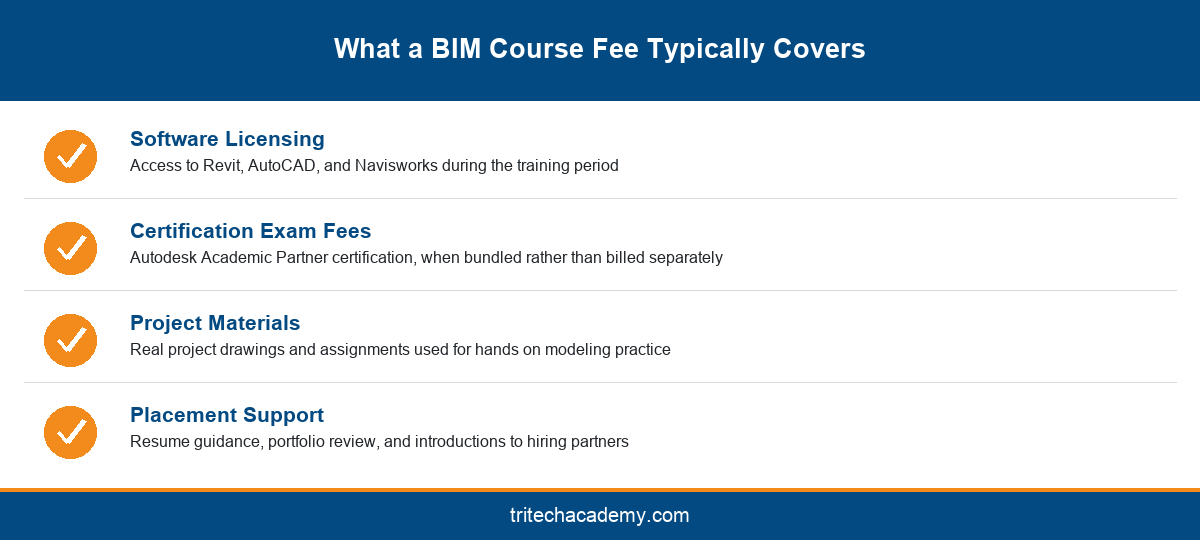
Four components typically make up a complete BIM course fee. Software licensing covers access to tools like Revit, AutoCAD, and Navisworks for the duration of training. Certification costs cover the Autodesk exam fee when an institute holds official Academic Partner status, since that certification is what verifies your skills against a recognized standard. Project materials refer to the drawings and assignments used for hands on modeling, ideally sourced from real projects rather than generic textbook exercises. Placement support covers resume guidance, portfolio review, and introductions to hiring partners once your coursework ends. At Tritech Academy, these four components are built into the BIM course fee from the start rather than introduced as add on charges midway through the program, which is one of the clearest ways to compare quotes from different institutes on equal terms.
It helps to think of a BIM course fee the same way you would evaluate a package deal rather than a single line item. Two institutes advertising a similar headline number can differ significantly once you account for whether certification, materials, and placement support are actually bundled in, or whether one of those components will show up as a separate invoice later. Asking for an itemized quote in writing, rather than a single total figure, makes this comparison far easier to do accurately.
How Fees Differ Across BIM Specializations
Not every BIM course fee looks the same, because specializations draw on different software licenses, project scopes, and coordination complexity. Understanding why costs vary by discipline helps you evaluate whether a quoted fee for BIM for Architecture, Civil and Structures, or MEP Integrated BIM is reasonable for what it actually covers.
BIM for Architecture typically centers on Revit for visualization, material scheduling, and construction documentation. BIM for Civil and Structures builds on that foundation with structural analysis, reinforcement detailing, and foundation design workflows, which often means additional modules and more complex real project drawings. MEP Integrated BIM tends to involve the most coordination work, since it requires modeling HVAC, electrical, and plumbing systems together using Navisworks alongside Revit to catch clashes between disciplines before construction begins. Because civil and MEP specializations often involve more complex coordination exercises and additional software modules, their course fee can sit higher than a purely architectural program. When comparing costs across specializations at any institute, ask specifically which software modules and certification tracks are included for that particular BIM course rather than assuming pricing is uniform across every discipline the institute offers.
Students combining a BIM course with an internship program should also check whether the two are priced together or separately, since internship placements often involve their own coordination with a host company and may carry a distinct fee structure from classroom based BIM training. Clarifying this upfront avoids confusion later if you decide to add an internship track after your BIM course has already started.
Questions to Ask Before You Get a Fee Quote
A short list of prepared questions makes it much easier to compare BIM course fee quotes fairly across institutes, rather than judging programs on headline price alone. Asking the right questions upfront also reduces the chance of encountering unexpected charges partway through your training.
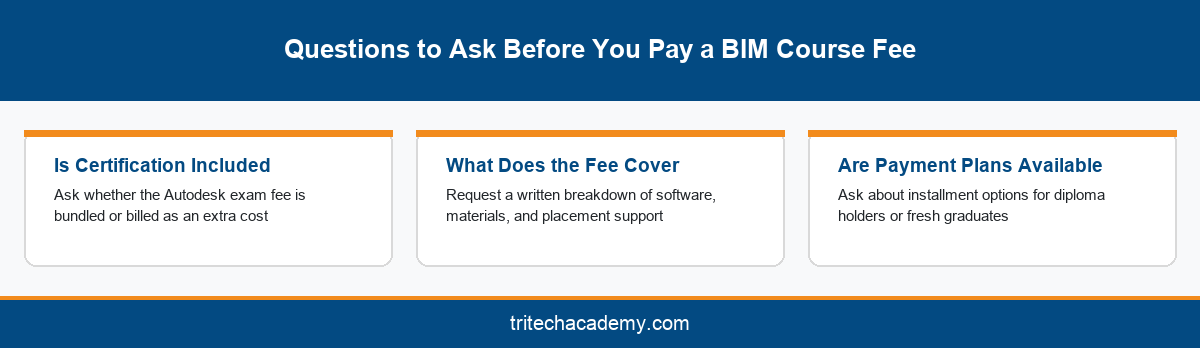
Start by asking whether the Autodesk certification exam fee is included in the quoted price or billed separately once you are ready to certify. Confirm whether project materials and software access continue for the full course duration or expire before certification is complete, since some programs limit access earlier than expected. Ask directly whether placement support is a guaranteed part of the program or an informal add on offered only to top performing students. It also helps to ask how many students are typically enrolled in a single batch, since smaller batches usually mean more individual feedback relative to your BIM course fee investment. Tritech Academy’s admissions team can walk through each of these points directly when you request a quote for any specialization.
Red Flags in Unclear BIM Course Pricing
A few warning signs suggest a BIM course fee may not be as straightforward as it first appears. Recognizing these patterns before you enroll can save you from costs that only become clear once you are already committed to a batch.
Be cautious of institutes that quote a very low headline fee but require separate payment for certification exams, continued software access, or placement assistance once you have already enrolled. Vague or shifting answers when you ask for a written fee breakdown are another signal worth taking seriously, as are institutes reluctant to specify exactly which software versions and modules are covered under the quoted BIM course fee. Pressure to enroll immediately without time to compare quotes from other institutes, or reluctance to put fee details in writing, are additional signs worth treating carefully. A transparent institute should be able to explain its fee structure clearly in a single conversation, with the same transparency expected of any recognized technical training body, such as AICTE, which oversees technical education standards in India, without needing repeated follow up clarifications after you have already committed to a batch.
How to Request Tritech Academy’s Current Fee Structure
Because batch schedules, specializations, and intake dates change regularly, Tritech Academy shares its current BIM course fee structure directly with prospective students rather than publishing a single fixed number that may not reflect the specialization or batch you are actually interested in.
The fastest way to get accurate pricing is to reach out through the contact page with the specific specialization you are considering, whether that is BIM for Architecture, BIM for Civil and Structures, or MEP Integrated BIM. When you reach out, mention whether you are a fresh graduate, diploma holder, or working professional, since this can affect which batch timing and payment options are available to you. You can also browse the full course catalogue to compare specializations side by side before requesting a quote, or visit the gallery to see the kind of project work your BIM course fee supports.
Where possible, it is worth scheduling a short call or an in person visit before finalizing payment, so you can ask follow up questions in real time rather than relying only on email exchanges. This also gives you a chance to confirm batch timing works with your schedule before committing your BIM course fee to a specific intake.
Conclusion
A BIM course fee is easiest to evaluate once you know what it should include, software licensing, certification, real project materials, and placement support, and how that pricing can shift depending on whether you choose an architecture, civil, or MEP specialization. Asking direct questions before enrolling, and watching for vague answers about what a quote covers, protects you from unexpected costs partway through training. If you are ready to compare specializations and get exact current pricing, contact Tritech Academy’s admissions team for a full breakdown suited to your chosen BIM course.
Frequently Asked Questions
What is typically included in a BIM course fee?
A BIM course fee usually includes software licensing for tools like Revit and Navisworks, Autodesk certification exam costs, real project materials for hands on practice, and placement support after training, rather than charging for each separately.
Does BIM course fee vary between specializations?
Yes, fees can vary by specialization since BIM for Architecture, Civil and Structures, and MEP Integrated BIM use different software modules and coordination complexity. MEP and civil specializations often involve additional modules that can affect pricing.
Are payment plans available for BIM training?
Some institutes offer installment based payment plans, particularly for diploma holders or fresh graduates enrolling shortly after graduation. It is reasonable to ask directly whether such options exist rather than assuming the listed fee is fixed.
Is Autodesk certification included in the course fee?
Certification inclusion depends on the institute. Programs run by an official Autodesk Academic Partner, like Tritech Academy, typically bundle certification costs into the quoted BIM course fee rather than billing it as a separate exam charge.
How do I compare BIM course fees across institutes fairly?
Ask each institute for a written breakdown covering software access, certification costs, project materials, and placement support. Comparing headline prices alone can be misleading if one quote excludes services another institute includes by default.
Does a higher BIM course fee always mean better training?
Not necessarily. A higher fee should correspond to more comprehensive software access, real project material, and placement support rather than just a longer classroom schedule. Always request specifics before assuming price reflects training quality.
What questions should I avoid skipping before enrolling?
Always confirm whether certification, software access, and placement support are included in the quoted price, how long software access lasts, and how many students are typically in a batch, since these details shape both cost and learning quality.
Can I get a personalized fee quote from Tritech Academy?
Yes, Tritech Academy provides current fee structures directly to prospective students based on specialization and batch availability. Learn more about the academy’s training approach on the About Tritech Academy page before reaching out for a quote.
Do internship programs have a separate fee from BIM courses?
Internship programs, such as the civil engineering internship program, may be priced separately from standalone BIM courses. Always confirm with Tritech Academy whether an internship track is bundled with your chosen specialization or billed independently.
What happens if I am unsure which specialization fits my budget?
Tritech Academy’s admissions team can walk through fee differences across BIM for Architecture, Civil and Structures, and MEP Integrated BIM based on your background and budget, helping you choose a specialization without guessing at costs.