
Introduction
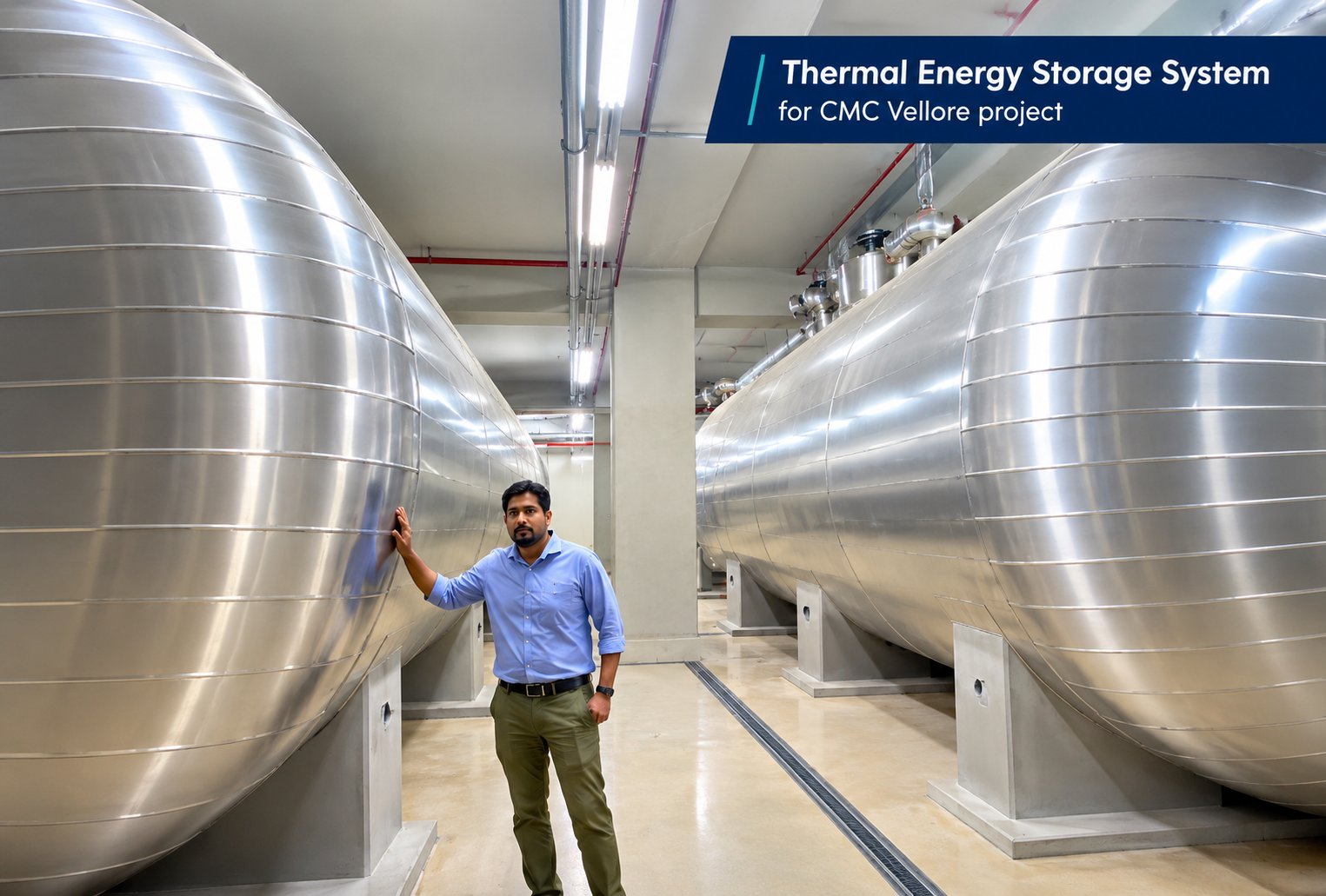
Efficient and reliable cooling is essential for large healthcare facilities, where uninterrupted building services play a vital role in supporting day-to-day hospital operations. At Christian Medical College (CMC), Vellore, the implementation of a Thermal Energy Storage (TES) system represents an important step towards managing central cooling demand through an integrated chiller and thermal storage arrangement.
Tritech Engineering is proud to highlight this project, featuring two 425 TR brine chillers, with a combined nominal capacity of 850 TR. The TES system has been installed and operational since 2022.
The project demonstrates the application of thermal energy storage technology in large-scale HVAC infrastructure, combining dedicated brine chillers with stored cooling energy to support the facility’s cooling requirements.
Understanding the TES System
Thermal Energy Storage is a cooling strategy in which thermal energy is generated and stored for use at a later time. In a TES-based air conditioning system, dedicated chillers produce cooling energy during designated charging periods, while the stored energy is subsequently used to supplement conventional chiller operation when required.
This approach provides flexibility in how cooling energy is generated and delivered, helping the facility manage variations in cooling demand throughout the day.
For large healthcare facilities, system design and operational coordination are particularly important to ensure that cooling requirements are met reliably.
Project Overview: 2 × 425 TR Brine Chillers
The CMC Vellore TES installation incorporates two water-cooled brine chillers, each with a nominal cooling capacity of 425 TR.
Key project details
- Project: Thermal Energy Storage System
- Client: Christian Medical College (CMC), Vellore
- Equipment: Water-cooled brine chillers
- Chiller configuration: 2 × 425 TR
- Combined nominal chiller capacity: 850 TR
- Operational since: 2022
- Application: Central air conditioning and thermal energy storage
The brine chillers form part of the TES arrangement, working in coordination with the associated cooling equipment and thermal storage infrastructure.
How the System Works
1. Cooling Energy Generation
The brine chillers generate cooling energy according to the system’s operating requirements and designated charging schedule.
2. Thermal Energy Storage
The generated cooling energy is stored in the TES system for subsequent use. The available storage capacity and charging strategy determine how much cooling energy can be delivered later.
3. Cooling During Demand Periods
When cooling demand increases, stored thermal energy can supplement the conventional chiller plant. This helps distribute the cooling load between direct chiller operation and stored cooling energy.
4. Integrated Plant Operation
The TES system operates as part of the wider central cooling infrastructure. Appropriate coordination between chillers, pumps, heat exchangers, storage equipment and controls is essential for effective system performance.
Why Thermal Energy Storage Matters in Healthcare Infrastructure
Large hospitals have complex cooling requirements arising from their building size, occupancy, operating schedules and diverse functional areas. Managing these requirements calls for careful planning of cooling capacity and equipment operation.
A TES-based arrangement can offer several operational advantages:
- Cooling-load management: Stored cooling can supplement conventional chillers during periods of higher demand.
- Operational flexibility: Cooling production and cooling delivery can be managed across different periods.
- Electrical demand management: Thermal storage may help reduce coincident peak electrical demand, depending on the operating strategy.
- Potential cost optimization: Electricity tariffs, demand charges and equipment efficiency influence the financial benefits.
- Integrated HVAC operation: TES technology can form part of a coordinated central cooling plant designed around the facility’s requirements.
The actual benefits depend on the plant configuration, control sequence, operating conditions and measured performance.
Engineering and System Integration
A successful TES installation requires more than selecting chillers of the appropriate capacity. It involves the integration of the cooling equipment, storage system, hydraulic arrangement, electrical infrastructure and controls.
Key engineering considerations include thermal storage sizing, charging and discharging requirements, cooling-load profiles, pumping arrangements, heat exchanger selection and coordinated chiller operation.
The CMC Vellore installation reflects the practical application of this technology within a large institutional HVAC environment.
An Operational TES Installation Since 2022
With the TES system operational since 2022, the CMC Vellore project represents an installed application of thermal energy storage in central air conditioning.
The system’s two 425 TR brine chillers provide a combined nominal capacity of 850 TR within the TES arrangement. Its operational history makes the installation relevant to discussions on thermal storage integration, large-scale cooling infrastructure and chiller-plant design.
Verified operating data, such as energy consumption, peak-demand reduction and annual operating costs, would provide a more detailed assessment of the system’s performance.
Conclusion
The Thermal Energy Storage system at CMC Vellore demonstrates the use of dedicated brine chillers and stored cooling energy as part of a large-scale central air conditioning strategy.
Featuring 2 × 425 TR brine chillers and operational since 2022, the installation highlights the importance of integrating thermal storage technology with conventional cooling equipment to manage building cooling requirements.
At Tritech Engineering, projects of this nature reflect our focus on HVAC engineering, central cooling systems and integrated building services solutions for complex institutional environments.